
.png)







Understanding exome and genome test results
Review the patient’s result
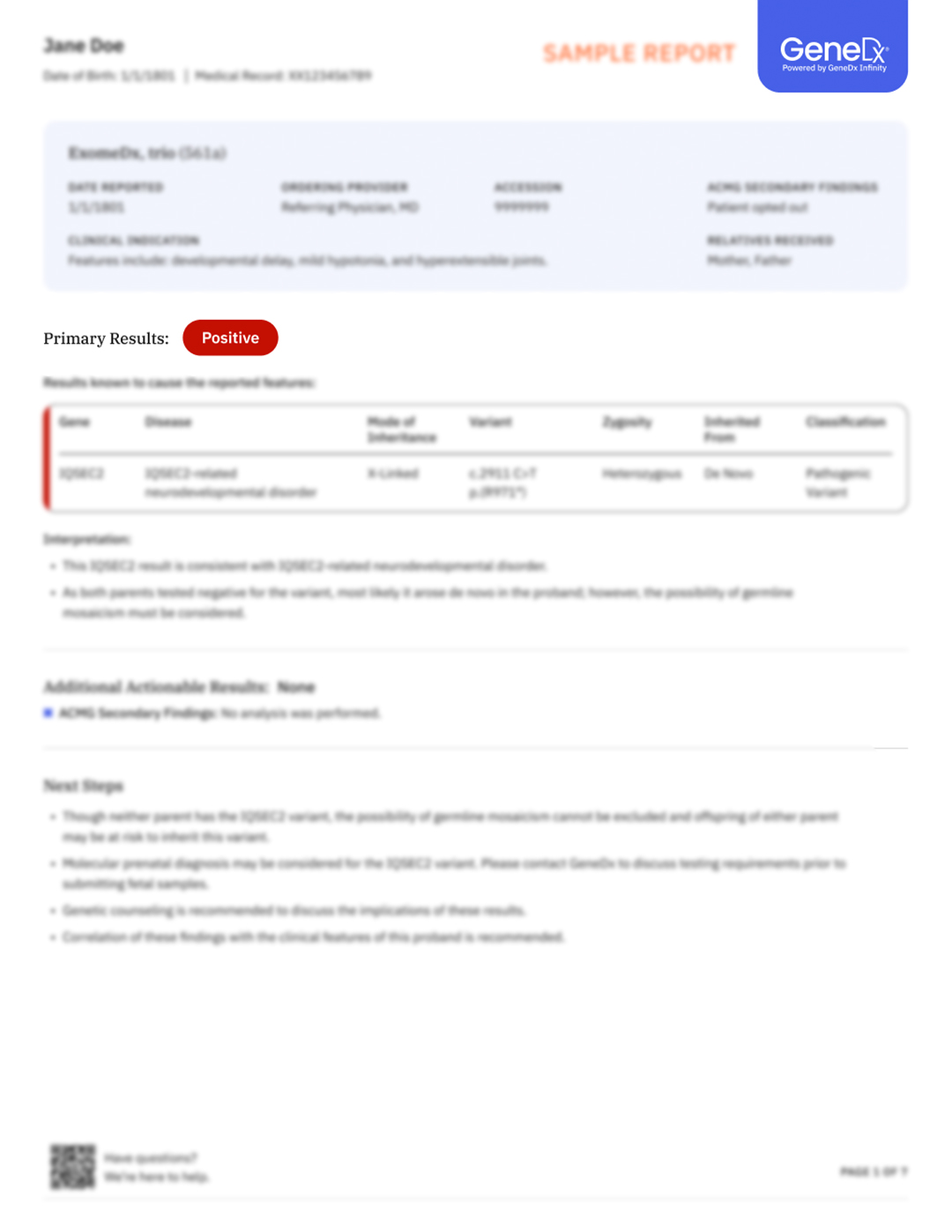
Important note: In some cases, there may be other variants identified by the test. These may include additional variants that are either potentially associated with the clinical features or considered additional actionable results.
You can find details about the gene and the condition, including common features, in the gene summary section of the report. Cross reference the patient’s presentation with the clinical features of the condition to determine whether all or part of the patient’s features are explained.
Identify relevant next steps


Share the results
“Waiting for answers can be difficult. We now have important information about what may be causing your child’s features.”
Coordinate a referral for genetic counseling, if desired
Genetic counseling supports families in understanding genetic test results and what they mean for the patient and other family members.
A genetic counselor can:
- Explain the results and how they may affect someone’s health and development
- Provide guidance on medical management and follow-up recommendations
- Review inheritance patterns
- Discuss implications and genetic testing options for family members and future pregnancies, if applicable
- Offer psychosocial support and coping strategies
- Connect families with support and advocacy groups and provide educational resources


Review the patient’s result
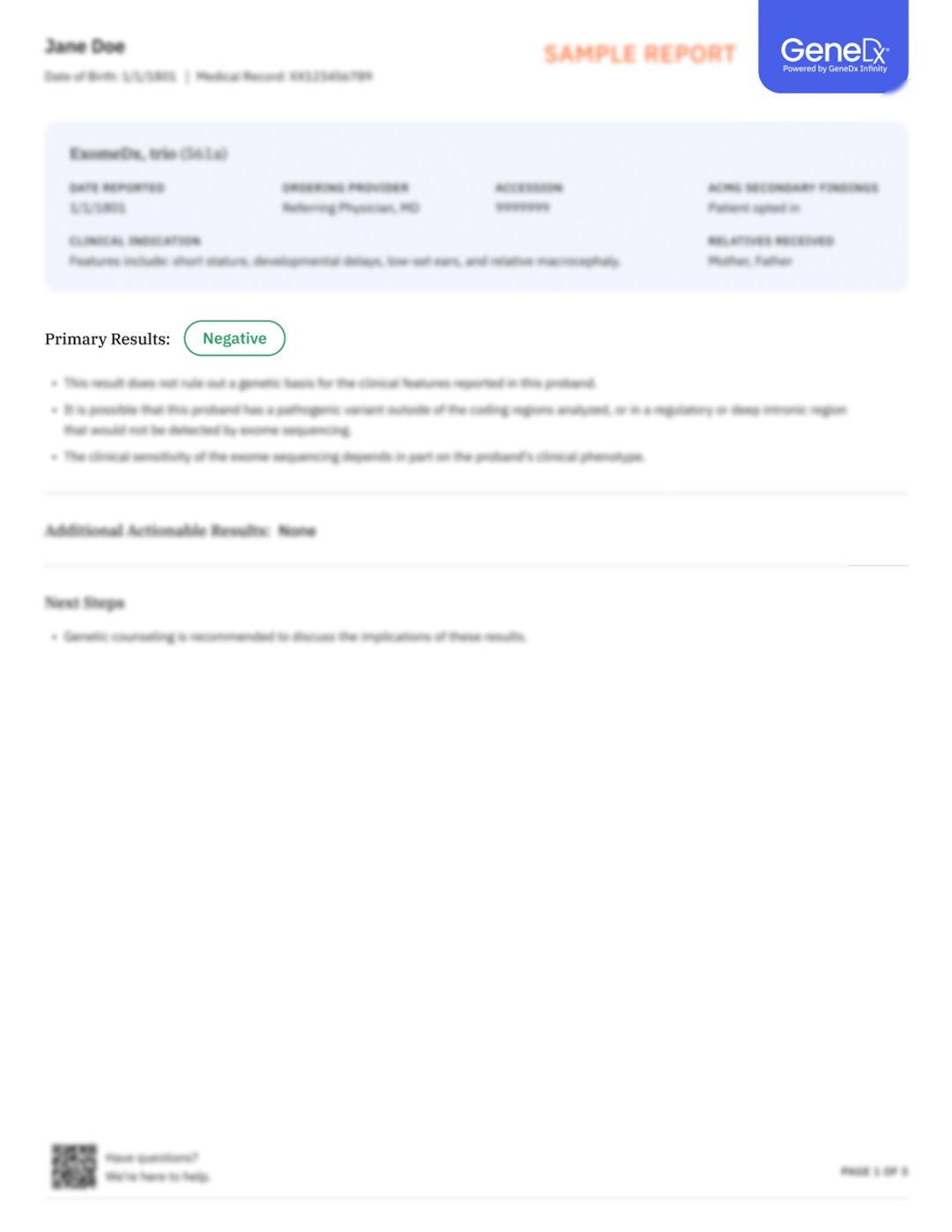
A negative result does not eliminate the possibility that the patient’s clinical features are due to an underlying genetic cause. The genetic cause may be in a region that wasn’t covered by this test, or a new link between a gene and disease may be discovered in the future. Explanations of the limitations of the test are detailed in the interpretation section of the report.
Important note: In some cases, there may be other variants included on the report. These may include additional actionable results.
Identify relevant next steps
Some families may want to stop testing at this point. Other families may be interested in knowing what additional testing may be relevant.

View the resource in Spanish here.
Share the results
Options might include:
• Additional diagnostic testing based on the patient’s clinical features
• Specialist consultations
• Ongoing clinical management and monitoring
• Reanalysis if symptoms change or in 1-2 years after initial testing (to allow time for new gene-disease discoveries)
Review the patient’s result
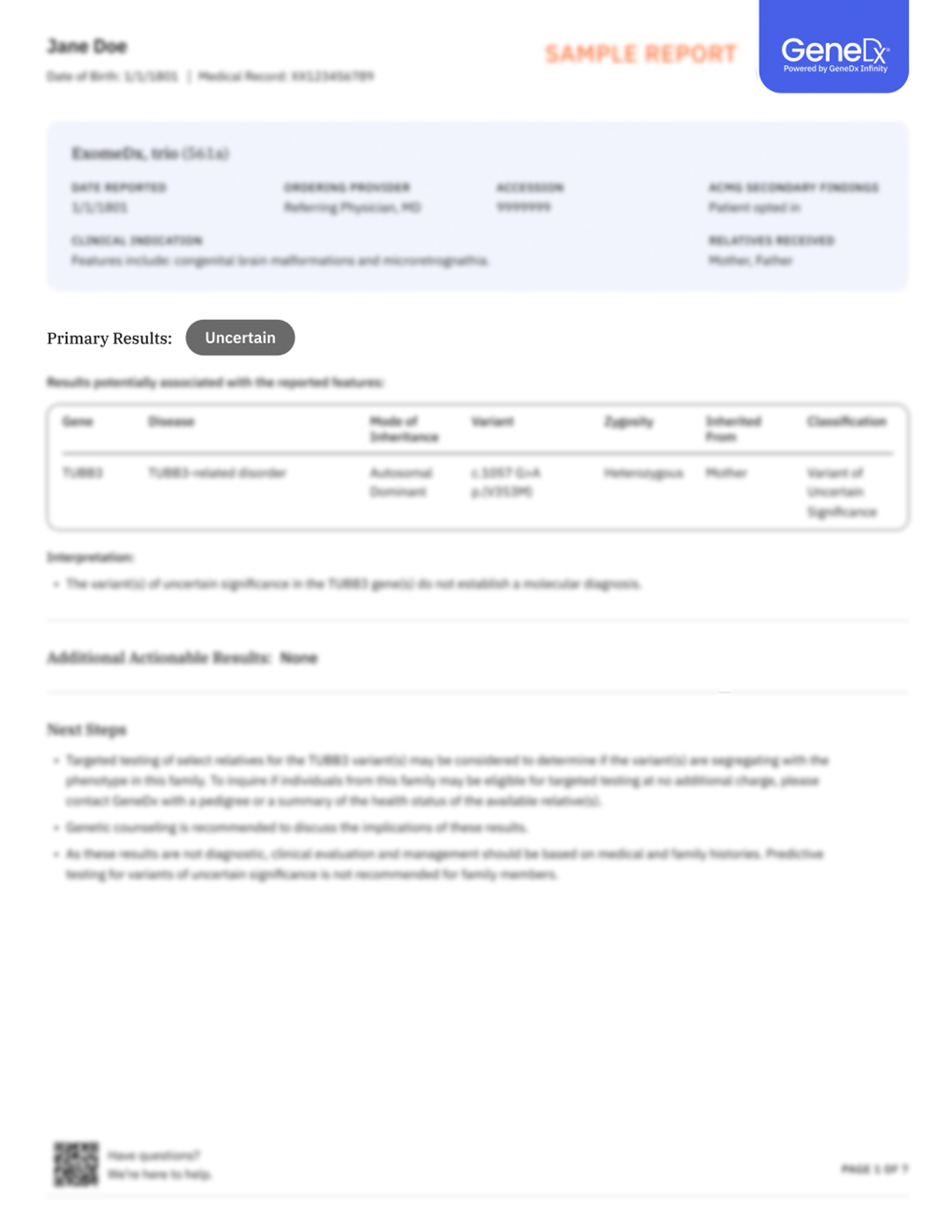
The reasons for an uncertain result can vary.
Some reasons may include:
- It’s unknown whether the variant causes human disease.
- The evidence linking the variant to human disease, but the patient’s clinical features don’t match the disease.
- The variant(s) are in a candidate gene. And while emerging scientific research supports a potential link between the gene and human disease, more studies are needed to make a definitive association.
Identify relevant next steps
Some families may want to stop testing at this point. Other families may be interested in knowing what additional testing may be relevant.

Share the results
• There is not enough evidence to know if the variant(s) causes human disease or is a variation of normal. We are still learning which variants contribute to genetic disease.
• The variant(s) are known to be associated with disease, but there is not currently enough evidence to determine whether it explains all or part of the patient’s presentation based on the reported features.
• There may be additional diagnostic testing indicated.
• Test biological parents if they have not been tested (Trio testing). Parental samples provide information about how variants are inherited. This context can sometimes provide enough evidence to shift a variant of uncertain significance to a conclusive positive or a conclusive negative.
• If symptoms change or develop, reanalysis can be requested.
Offer a referral for genetic counseling, if desired
Genetic counseling supports families in understanding genetic test results and what they mean for the patient and other family members.
A genetic counselor can:
- Explain the results
- Provide guidance on medical management and follow-up recommendations
- Review inheritance patterns
- Discuss implications and genetic testing options for family members and future pregnancies, if applicable
- Offer psychosocial support and coping strategies
- Connect families with support and advocacy groups and provide educational resources
Review the patient’s result
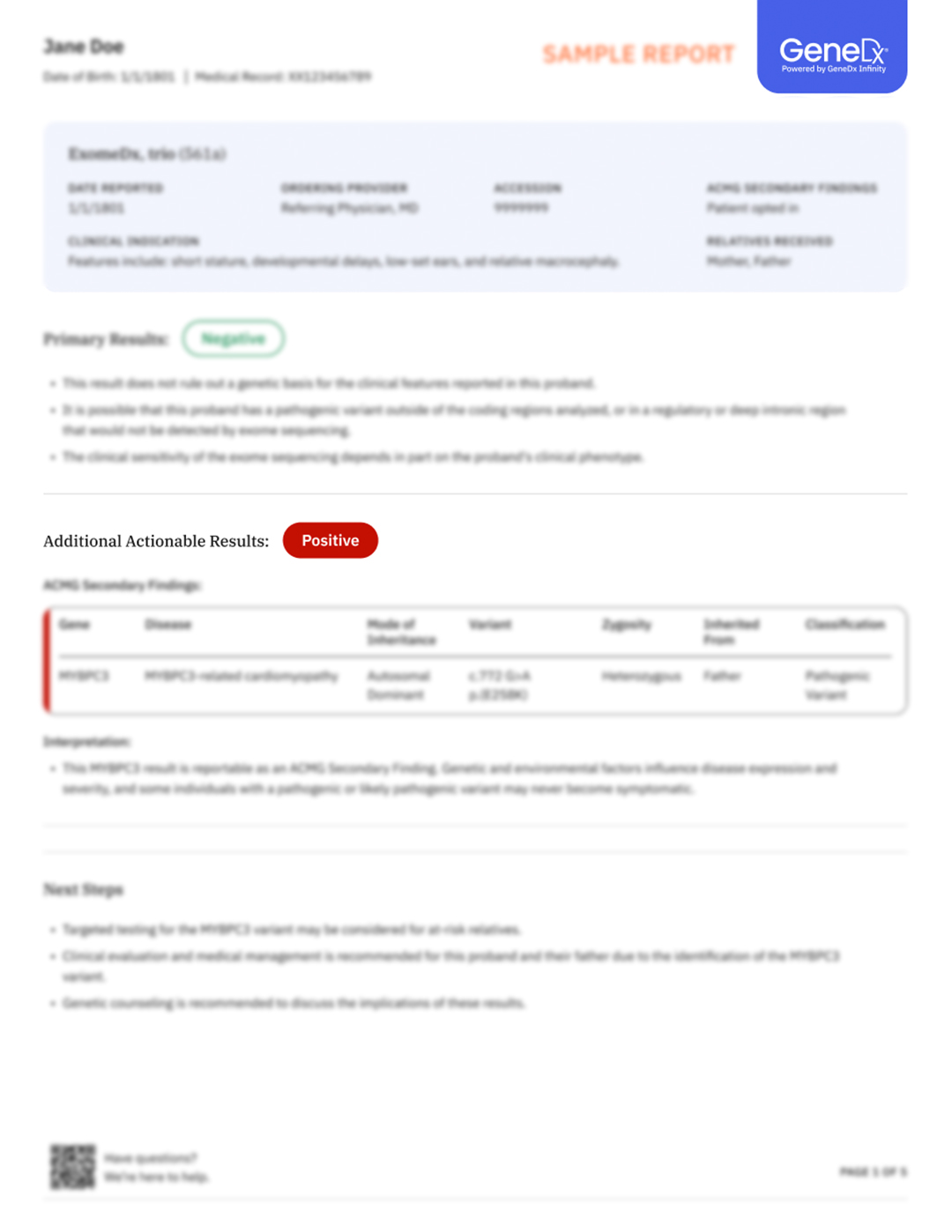
A "Positive" Additional Actionable Result means the testing identified a genetic variant that is not related to the patient’s current clinical features or medical concerns.
There are two different types of results that may be reported in this section:
- ACMG Secondary Findings are a set list of well characterized conditions. Pathogenic and/or likely pathogenic variants in these genes are medically actionable. You can access an ACMG Secondary Findings patient handout here.
- Additional Reportable Findings are pathogenic or likely pathogenic variants that are associated with serious medical conditions in children.
Detailed information about the variant(s) are presented in tables. The Gene Summary section of the report, found after the Next Steps, will provide more details.
Identify relevant next steps

Share the results
Include referrals to relevant specialists and consider testing any first degree relative of the patient who has not been previously tested.
Offer a referral for genetic counseling, if desired
Genetic counseling supports families in understanding genetic test results and what they mean for the patient and other family members.
A genetic counselor can:
- Explain the results and how they may affect someone’s health and development
- Provide guidance on medical management and follow-up recommendations
- Review inheritance patterns
- Discuss implications and genetic testing options for family members and future pregnancies, if applicable
- Offer psychosocial support and coping strategies
- Connect families with support and advocacy groups and provide educational resources
Glossary
ACMG
American College of Medical Genetics and Genomics; interdisciplinary professional organization that represents the entire medical genetic field including clinical geneticists, genetic counselors, and clinical laboratory geneticists. More information at acmg.net.
ACMG Secondary Findings
The ACMG maintains a list of genes that are associated with health conditions for which medical screening and/or treatments are available. Variants in these genes are not related to the primary reason for testing.
Additional Reportable Findings
A reported genetic variant that is not related to the patient's current clinical features or medical concerns. This result is reported because it's well characterized and known to be associated with childhood disease with significant morbidity and/or mortality.
Classification
The level of evidence that supports the relationship between a genetic variant and a disease.
Pathogenic: Known to cause disease
Likely Pathogenic: Likely causes disease
Variant of Uncertain Significance: Unknown relationship to disease
Clinical Indication
Section of the GeneDx report that describes key clinical features of the patient, provided by the ordering provider. This list may not be all inclusive, and a list of human phenotype ontology (HPO) terms used in the analysis is listed on a subsequent page of the report.
Copy Number Variant (CNV)
A type of genetic change involving a deletion or duplication of a segment of DNA. Excluding the sex chromosomes, it is typical to have two copies of every region of the genome (one from their mom and one from their dad). Copy number variants increase or decrease the number of copies present.
Disease
On an exome or genome report, this refers to genetic disease. A genetic disease is a condition caused by a change in the DNA that disrupts normal protein function and leads to clinical features associated with the condition.
Gene
A defined region of the genome that contains the code needed to build a protein. Genes are located on chromosomes. Most genes have two copies, one from mom and one from dad.
Gene Summary
Section of the GeneDx report that provides detailed molecular and clinical information for every gene in the report.
Inherited From
Describes the origin of the genetic variant.
Father: Variant inherited from the biological father
Mother: Variant inherited from the biological mother
De novo: Variant occurred spontaneously in the patient (not inherited from either parent)
Unknown: Parents were not sequenced and therefore it is unknown how the variant was inherited
Interpretation
Section of the GeneDx report that provides written interpretation of the genetic variants in the report.
Mode of Inheritance
Describes the way a condition is inherited based on what is known about the function of the variant and the gene.
Autosomal Dominant: One altered copy of a gene causes disease.
Autosomal Recessive: Two altered copies of a gene are required to cause disease; parents are typically unaffected carriers (they only have one altered copy) and each passed down a single altered copy of the gene.
X-Linked: The altered gene is on the X chromosome. Males are more often affected than females. Females can range from unaffected to mildly affected to severely affected.
mtDNA
Short for mitochondrial DNA, mtDNA is DNA found outside the nucleus inside specialized organelles called mitochondria. mtDNA is always inherited from the biological mother. mtDNA is included in GenomeDx and ExomeDx + Mito tests.
Multi-gene deletion
A type of copy number variant (CNV) in which a segment of DNA containing multiple genes is missing. This results in fewer copies of those genes than expected and may affect how they function.
Multi-gene duplication
A type of copy number variant (CNV) in which a segment of DNA containing multiple genes has an extra copy. This results in more copies of those genes than expected and may affect how they function.
Nuclear DNA
99% of our DNA that is found inside the nucleus of a cell, packaged into chromosomes. The remaining 1% of our DNA lives outside the nucleus in specialized organelles called mitochondria and is called mitochondrial DNA.
Primary Result
The overall descriptor of the test result and its significance for the patient (positive, negative, or uncertain).
Variant
A difference in the DNA that may or may not impact gene function for health. The average person has 4-5 million variants, but the majority of them have no impact on human health.
Variant Interpretation
The classification that GeneDx uses for a variant identified in a patient, and the scientific evidence which supports the classification.
Zygosity
Refers to whether a variant is present in one or both copies of a gene.
Heterozygous: A variant is present in one copy of the gene (i.e. 1 altered copy; 1 normal copy). Someone who is compound heterozygous has a variant present in one copy of the gene AND a different variant in the other copy of that gene (i.e. 2 altered copies).
Homozygous: The same variant is present in both copies of the gene (i.e. 2 altered copies).
Hemizygous: Males only have one X chromosome. Therefore, if a variant is present in a gene on the X chromosome in a male, we call it hemizygous.